

07 Oct Prof. Calzada’s Forthcoming Routledge Chapter Explores Trustworthy GenAI in Public Healthcare
15 October 2026 | Forthcoming Book Chapter | Routledge | Research Available on SSRN
Professor Igor Calzada, affiliated with the University of the Basque Country (EHU) and Ikerbasque–Basque Foundation for Science authored a forthcoming chapter examining how patients and general practitioners can participate in shaping trustworthy generative artificial intelligence (GenAI) in public healthcare.
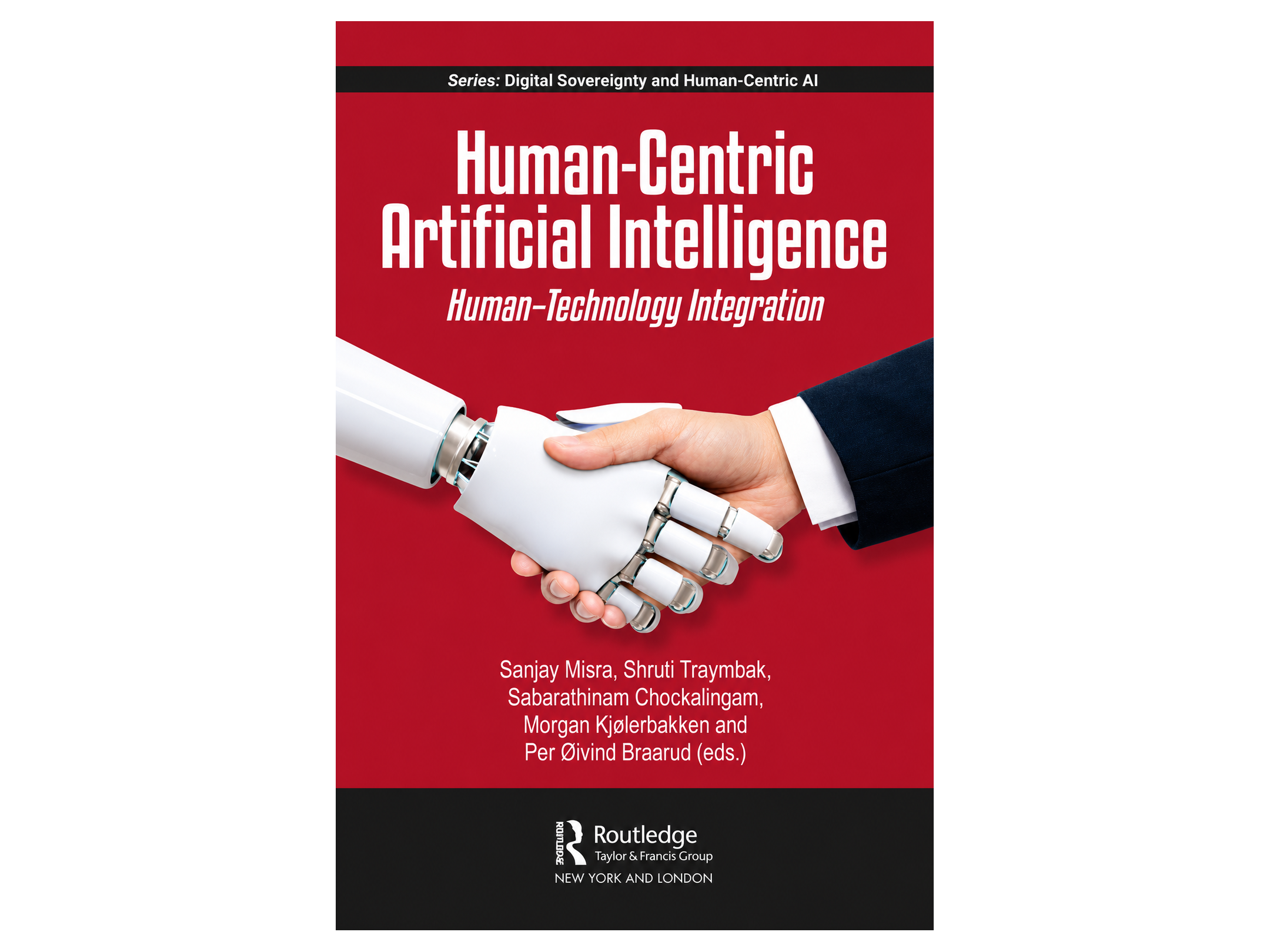
The contribution forms Chapter 11 of Human-Centric Artificial Intelligence: Human–Technology Integration, forthcoming from Routledge with a 2027 copyright date. The volume belongs to the Digital Sovereignty and Human-Centric AI series and brings together interdisciplinary perspectives on the relationship between artificial intelligence, human values and institutional responsibility. Routledge
At the centre of the chapter is a question: how can public healthcare anticipate GenAI while protecting clinical judgement, patient agency and democratic accountability?
Co-Producing Human–AI Governance in the Basque Country
Focusing on Osakidetza, the Basque public healthcare system, and Biogipuzkoa, the chapter explores how human–AI governance can become a practical, participatory process rather than remain an abstract set of principles. It draws on qualitative action research involving general practitioners and patients in a primary care setting in Donostia–San Sebastián, combining co-design workshops, focus groups and ethnographic observation.
The research developed from the 2025 International Summer School on Digital Inclusion & Generative AI. Subsequent living lab activities created opportunities for healthcare professionals and patients to explore potential applications, articulate concerns and identify conditions for responsible adoption. The emphasis was on anticipating institutional and ethical challenges before wider implementation.
The central argument is that trustworthy GenAI cannot be secured through technical safeguards alone. Patients and healthcare professionals need a meaningful role in shaping the rules, responsibilities and institutional arrangements governing its use.
Five Connected Challenges for Trustworthy GenAI
The chapter identifies five interdependent challenges emerging from the engagement with GPs and patients:
- Epistemic uncertainty and clinical judgement: positioning GenAI as support for human expertise, rather than a substitute for professional judgement and relational care.
- Trust and explainability: making AI involvement and its outputs understandable to both healthcare professionals and patients.
- Accountability and error: clarifying responsibilities across clinicians, healthcare institutions and technology providers.
- Data ownership and consent: enabling patients to participate meaningfully in decisions about how their health data are accessed and used.
- Digital divides and access: ensuring that adoption does not exclude people facing barriers related to age, digital literacy, geography or socioeconomic circumstances.
These concerns are brought together in a framework linking clinical autonomy, public trust, shared accountability and equitable access.
From Living Labs to Participatory Healthcare Governance
The chapter proposes living labs as continuing settings for dialogue, co-design and oversight. Rather than treating participation as a one-off consultation, this approach would allow patients, clinicians, researchers and policymakers to revisit emerging risks and adapt safeguards as technologies and institutional needs evolve.
Its policy agenda combines the institutionalisation of living labs with procurement principles that preserve clinical judgement, explanations tailored to professional and public audiences, clear accountability arrangements, participatory health data governance and non-digital access alternatives. Health data cooperatives are explored as one possible mechanism for strengthening patient agency and collective stewardship.
The findings are exploratory and qualitative, addressing largely hypothetical or early-stage GenAI applications. Their contribution is an anticipatory governance agenda and a methodology for further investigation, rather than evidence of clinical effectiveness at scale. Replication would require adaptation to different healthcare settings, sustained resources and further longitudinal and comparative research.
Forthcoming Publication and Research Access
The research is available to read on SSRN ahead of the book’s publication. Smart City Research
View the book and contents on Routledge
To Cite This Chapter
Calzada, I., & Garaikoetxea, A. (2027). Anticipating trustworthy GenAI in the public healthcare system: Co-producing human–AI governance between patients and GPs in the Basque Country through living lab assemblages. In S. Misra, S. Traymbak, S. Chockalingam, M. Kjølerbakken, & P. Ø. Braarud (Eds.), Human-Centric Artificial Intelligence: Human–Technology Integration (pp. 288–319). Routledge. https://doi.org/10.1201/9781003635871.
Professor Calzada thanks the volume’s editors—Sanjay Misra, Shruti Traymbak, Sabarathinam Chockalingam, Morgan Kjølerbakken and Per Øivind Braarud—for bringing together this interdisciplinary contribution to human-centric artificial intelligence.
Sorry, the comment form is closed at this time.