

09 Mar Prof. Calzada Publishes Open Access Article in Cambridge University Press’s Data & Policy: The Illusion of Web3 Decentralization
9 March 2026 | Research Publication | Cambridge University Press | Open Access
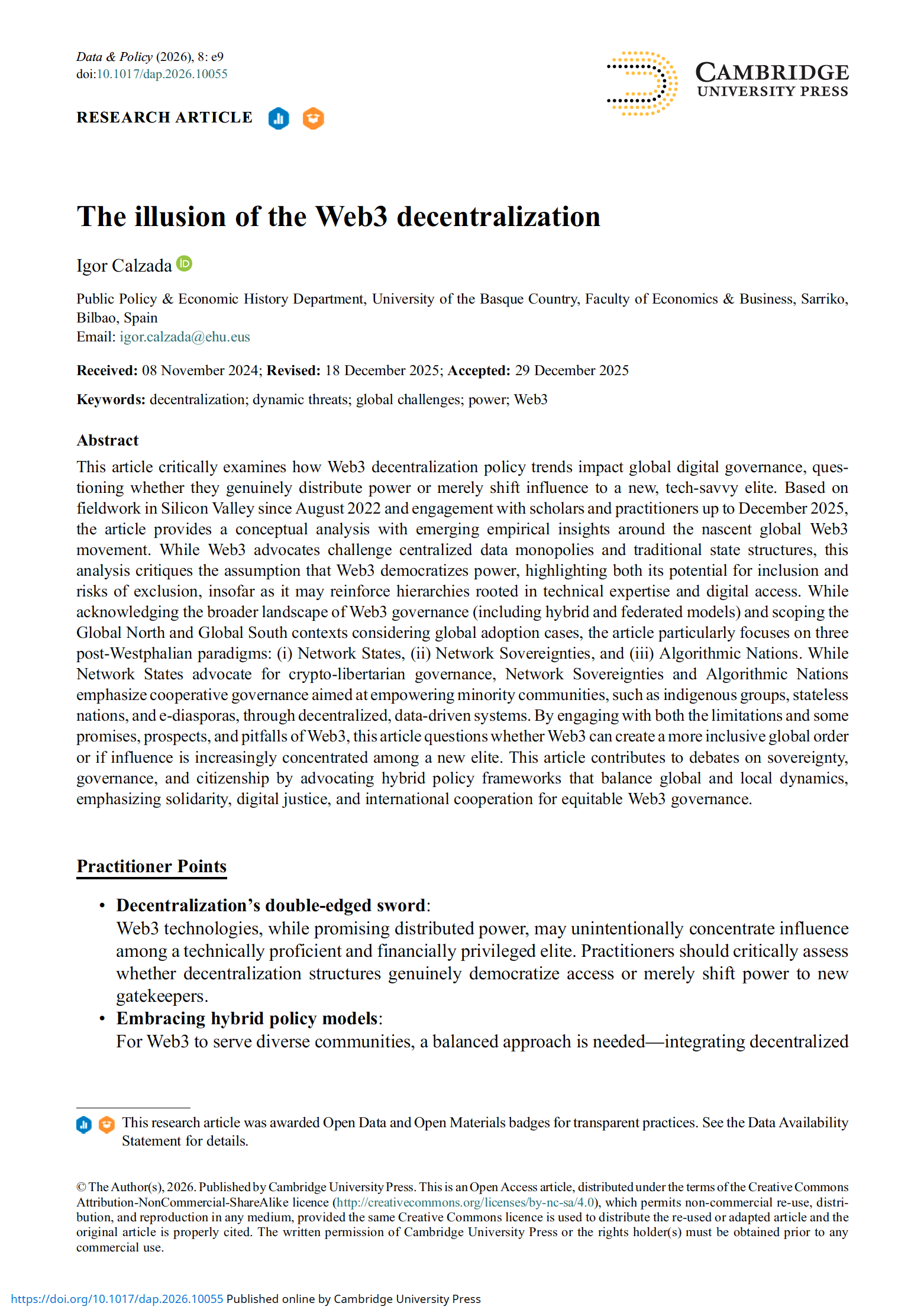
Professor Igor Calzada, affiliated with the University of the Basque Country (EHU) and Ikerbasque, the Basque Foundation for Science, has published a peer-reviewed research article entitled “The Illusion of the Web3 Decentralization” in Data & Policy (Volume 8, e9), published by Cambridge University Press.
The Open Access article critically examines one of the central promises of Web3: whether decentralized technologies genuinely redistribute political and economic power or merely replace established forms of technological concentration with new digitally empowered elites.
Drawing upon fieldwork in Silicon Valley initiated in August 2022 and continued engagement with scholars and practitioners through December 2025, the research investigates the implications of blockchain-based decentralization for global digital governance, sovereignty and citizenship.
Beyond the Promise of Decentralization
Web3 has frequently been presented as an alternative to centralized digital platforms, data monopolies and established institutional hierarchies. Yet decentralization at the technological level does not necessarily translate into democratic accountability, equitable participation or the redistribution of power.
The article examines this tension by considering how technical expertise, digital access, financial resources and control over digital infrastructures may reproduce inequalities within ostensibly decentralized ecosystems.
Rather than dismissing Web3 altogether, the analysis identifies both its emancipatory possibilities and its institutional, economic and political limitations.
Three Emerging Paradigms of Digital Sovereignty
A central contribution of the paper is its comparative conceptual examination of three post-Westphalian governance paradigms:
1. Network States
Emerging forms of network-based political organisation associated with crypto-libertarian governance, market-driven coordination and digitally mediated membership.
2. Network Sovereignties
Alternative arrangements emphasising collective governance, cooperative institutions and the potential of decentralized technologies to support communities beyond conventional territorial structures.
3. Algorithmic Nations
Data-driven and technologically mediated forms of collective organisation that may enable stateless nations, Indigenous communities, minority groups and transnational diasporas to develop new expressions of digital citizenship and sovereignty.
By comparing these paradigms, the article highlights the diversity of political visions associated with Web3 and the need to distinguish technological decentralization from genuinely inclusive governance.
Implications for Public Policy and Global Digital Governance
The study argues for governance arrangements that move beyond a simplistic opposition between centralized and decentralized systems.
It advocates hybrid policy frameworks capable of combining technological experimentation with democratic accountability, cooperative governance, digital justice, solidarity and international cooperation.
These considerations are particularly relevant to public policymakers, digital regulators, researchers and civil society organisations assessing the emerging relationship between AI, blockchain infrastructures and the distribution of technological power.
The article contributes to interdisciplinary discussions across Political Economy, Public Policy, Digital Governance, International Relations, Regional Studies and Digital Citizenship.
Open Access Publication
Full reference:
Calzada, I. (2026). The Illusion of the Web3 Decentralization. Data & Policy, 8, e9. Cambridge University Press.
Published online: 9 March 2026
DOI: https://doi.org/10.1017/dap.2026.10055
Open Access article: Read the published version at Cambridge Core
SSRN version: Access the research on SSRN
SSRN DOI: https://doi.org/10.2139/ssrn.5008910
The Cambridge University Press publication is available under a Creative Commons Attribution-NonCommercial-ShareAlike (CC BY-NC-SA 4.0) licence.
Sorry, the comment form is closed at this time.