

10 Oct Prof Calzada Included in the 2026 Stanford–Elsevier World’s Top 2% Scientists Database
Prof Calzada Included in the 2026 Stanford–Elsevier World’s Top 2% Scientists Database
11 October 2026 | Research & Academic Recognition
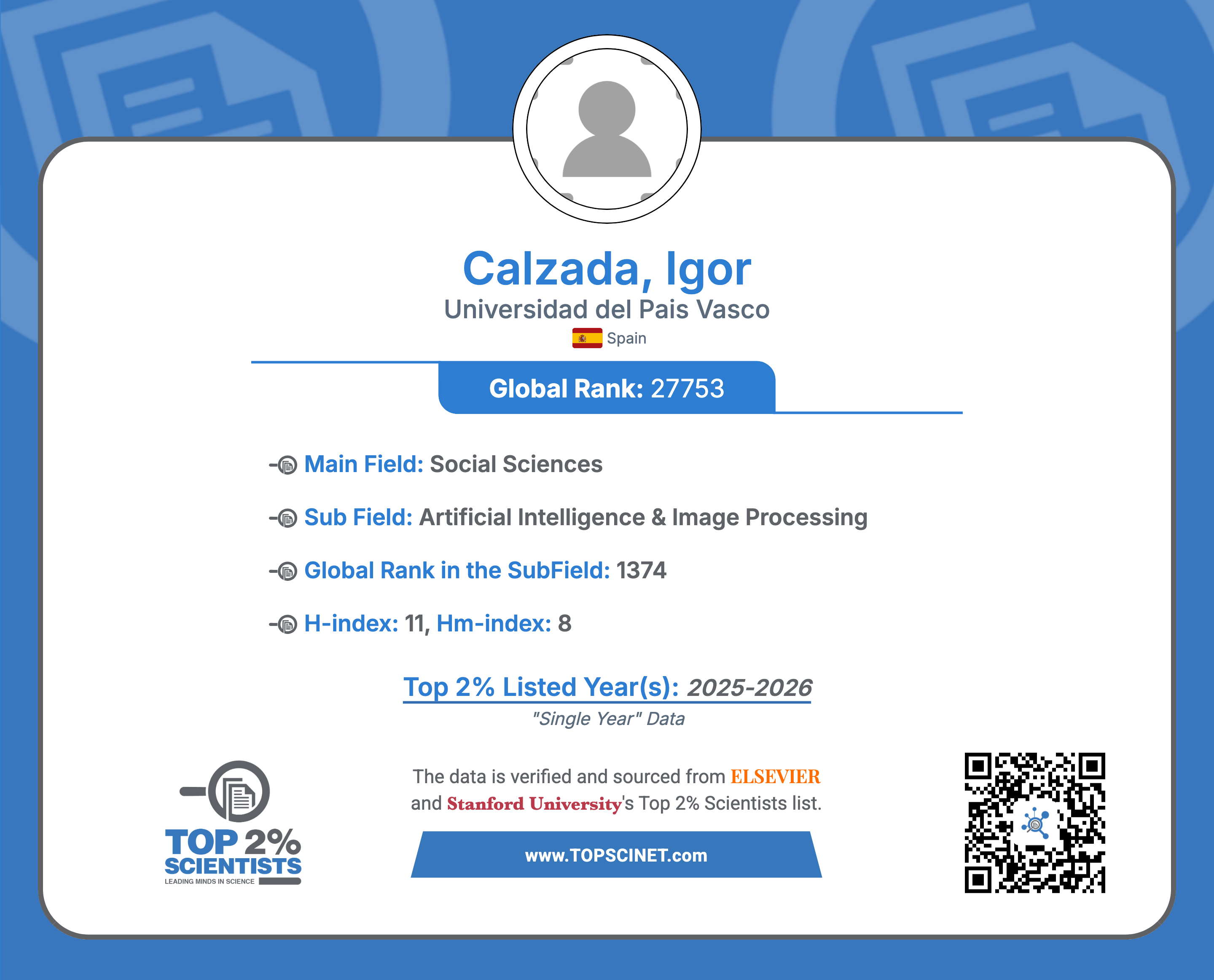
Professor Dr Igor Calzada, affiliated with the University of the Basque Country (EHU/UPV) and Ikerbasque–Basque Foundation for Science, has been included in the 2026 Stanford–Elsevier World’s Top 2% Scientists database, recognising the international citation impact of his academic research.
The latest edition of the Updated science-wide author databases of standardized citation indicators, compiled by John P. A. Ioannidis and published through the Elsevier Data Repository on 7 October 2026, draws on Scopus citation data across scientific disciplines.
International Research Impact: 2026 Results
In the single-year citation-impact ranking, based on citations received during 2025, Professor Calzada achieved:
- Global rank: 27,753
- Rank in Artificial Intelligence & Image Processing: 1,374
- Main scientific field: Social Sciences
- Institutional affiliation: University of the Basque Country (EHU/UPV)
These rankings are calculated using indicators excluding self-citations. Professor Calzada is also included in the separate career-long citation-impact database.
The disciplinary classification reflects the database’s bibliometric methodology, which assigns research fields and subfields according to indexed publications.
Interdisciplinary Research Across AI, Governance and Regional Development
Professor Calzada’s research connects artificial intelligence, digital citizenship, political economy, urban and regional development, and territorial governance.
His interdisciplinary academic contributions examine how technological transformation, institutional arrangements and emerging digital economies shape contemporary societies and regions.
The inclusion in the 2026 database provides an additional indicator of the international scholarly visibility of this research, particularly at the intersection of the social sciences, technological transformation and public policy.
Understanding the Stanford–Elsevier Database
The database uses a composite citation indicator (c-score) incorporating citations, the h-index, co-authorship-adjusted indicators and authorship positions.
Commonly described as the World’s Top 2% Scientists list, it includes researchers qualifying through their overall citation-impact ranking or their position within a scientific subfield.
The database is a bibliometric research resource rather than an individual award from Stanford University. Its indicators provide evidence of scholarly citation impact and should be interpreted alongside wider measures of research quality, originality and societal contribution.
Source and Further Information
Ioannidis, J. P. A. (2026). August 2026 data-update for Updated science-wide author databases of standardized citation indicators. Elsevier Data Repository, Version 9.
Methodological publication: Ioannidis, Boyack and Baas (2020), Updated science-wide author databases of standardized citation indicators, PLOS Biology.
Keywords: Stanford–Elsevier, Top 2% Scientists, Research Impact, Igor Calzada, Ikerbasque, EHU, Artificial Intelligence, Social Sciences, Digital Citizenship, Regional Development, Academic Recognition.
Sorry, the comment form is closed at this time.