

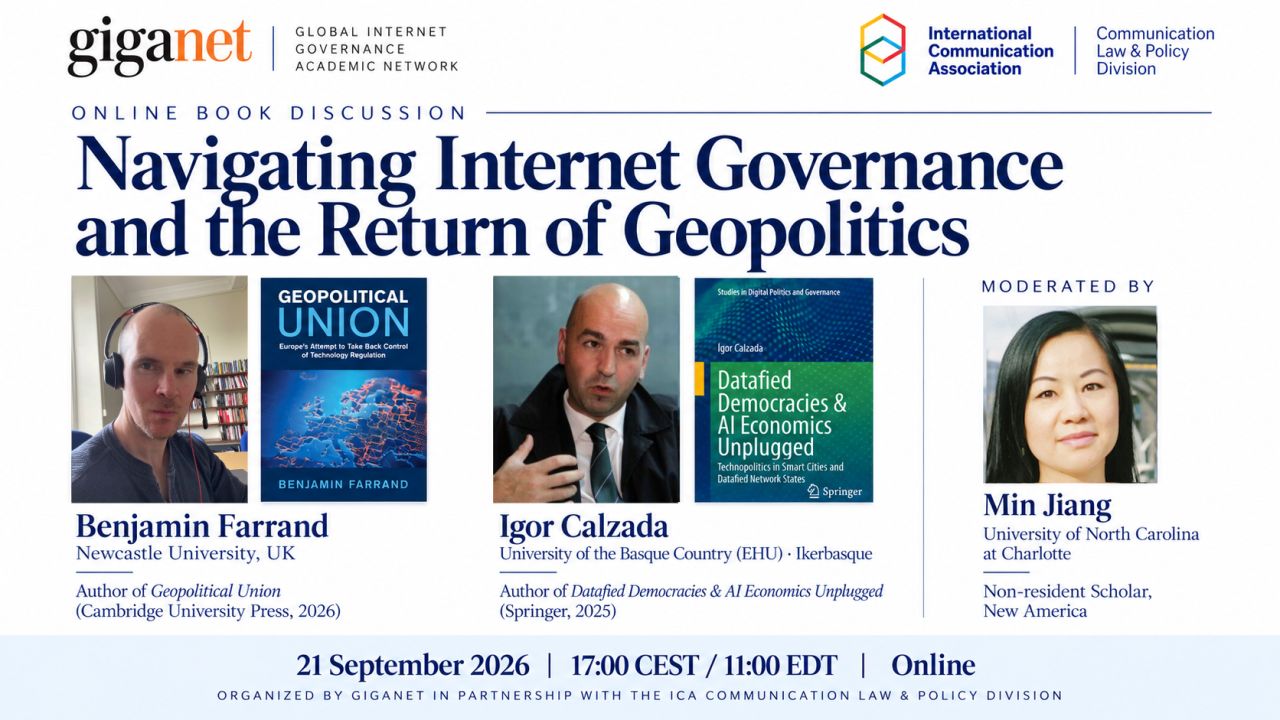
21 Sep Prof Calzada Discusses Datafied Democracies & AI Economics at the GigaNet Event on Internet Governance and the Return of Geopolitics
Professor Igor Calzada joined Benjamin Farrand and moderator Min Jiang for a GigaNet and ICA book discussion examining how geopolitical competition, technological dependence and AI are transforming internet governance.
On 21 September 2026, Professor Igor Calzada participated in the international online book discussion Navigating Internet Governance and the Return of Geopolitics, organised by the Global Internet Governance Academic Network (GigaNet) in partnership with the Communication Law and Policy Division of the International Communication Association (ICA).
The 78-minute event brought together Professor Calzada and Benjamin Farrand, Professor of Law and Emerging Technologies at Newcastle University. The conversation was moderated by Min Jiang, Professor of Communication Studies at the University of North Carolina at Charlotte.
Two books, one geopolitical question
The discussion placed two recent monographs in dialogue:
- Benjamin Farrand, Geopolitical Union: Europe’s Attempt to Take Back Control of Technology Regulation, Cambridge University Press, 2026.
- Igor Calzada, Datafied Democracies & AI Economics Unplugged: Technopolitics in Smart Cities and Datafied Network States, Springer, 2025.
Farrand’s book examines how geopolitical instability has encouraged the European Union to pursue digital and technological sovereignty through regulation, industrial policy and greater control over strategic areas including AI, data, digital platforms, microchips and technological standards.
Calzada’s book broadens this discussion by examining how AI, datafication, platform power and Web3 decentralised technologies are reorganising democracy, economic life and political authority across smart cities and emerging datafied network states.
Who represents us in the age of AI?
Professor Calzada structured his intervention around a central question: who represents citizens when digital infrastructures increasingly mediate access, visibility, classification and political participation?
He introduced AI economics as the political economy of how value is created, extracted, distributed and governed through data and algorithmic systems. He also described datafied democracies as societies in which democratic representation increasingly operates through infrastructures controlled by platforms, states and other powerful organisations.
The presentation connected this argument with several themes developed across the book:
- technopolitics and the concentration of power in data-opolies;
- trustworthy AI and institutional accountability;
- the promises and limitations of Web3 decentralisation;
- plural forms of data sovereignty;
- data cooperatives and public digital infrastructure;
- post-Westphalian political authority;
- innovation systems for democratic resilience;
- “unplugging” as a method for questioning technological inevitability.
Internet governance beyond infrastructure
The event demonstrated why contemporary internet governance can no longer be understood solely through connectivity, technical standards or online content regulation. It must also address the political economy of AI, control over digital infrastructures, strategic technological dependencies and citizens’ capacity to contest the decisions shaping their lives.
Together, the two books invite researchers and policymakers to examine whether technological sovereignty and state capacity can strengthen democratic agency, or whether they risk reproducing new forms of concentration, exclusion and geopolitical fragmentation.
Watch the complete recording:
https://youtu.be/QyIMuNLCgg0
Event information:
https://giga-net.org/navigating-internet-governance-and-the-return-of-geopolitics/
Sorry, the comment form is closed at this time.