

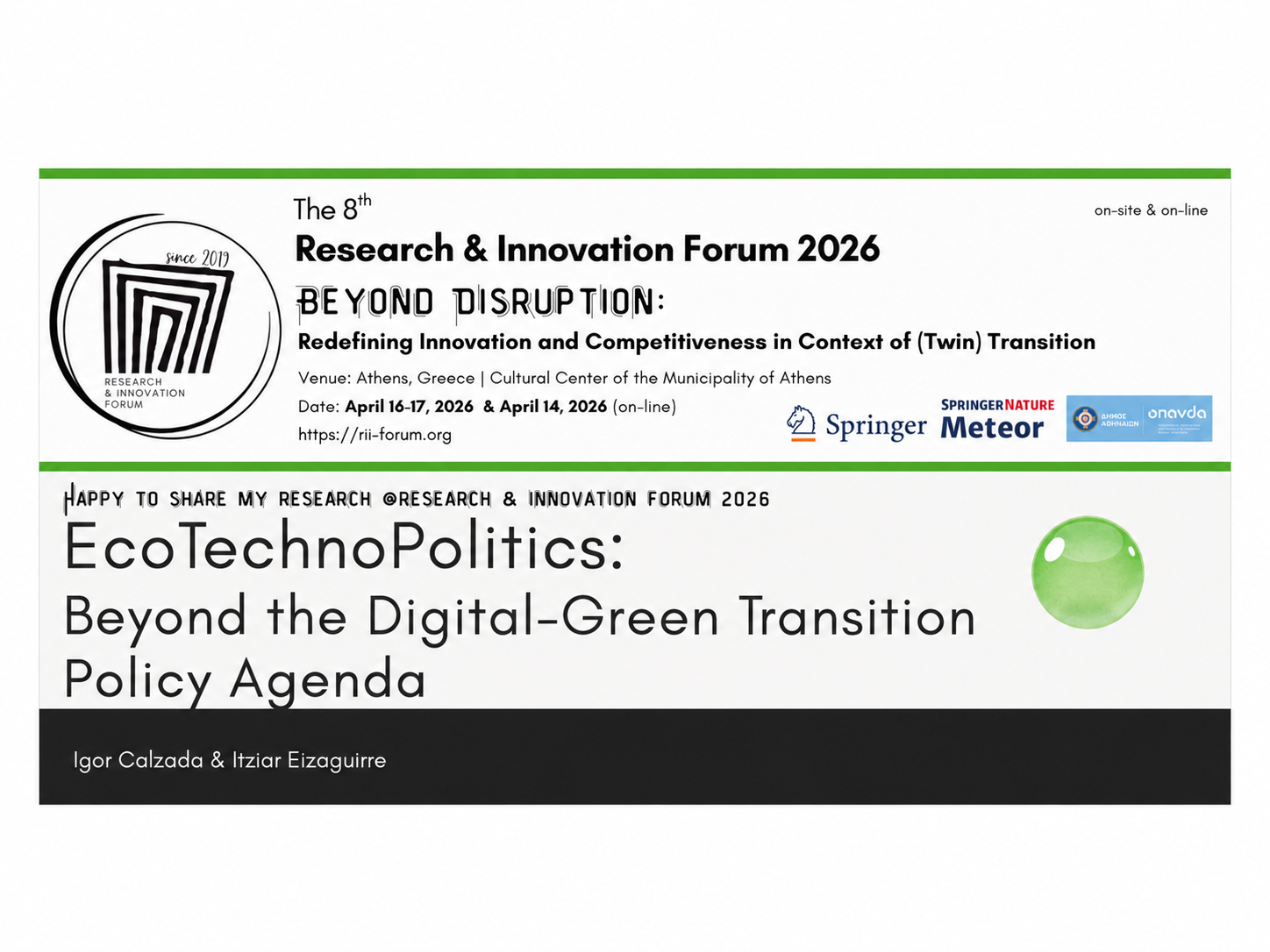
16 Apr EcoTechnoPolitics: Beyond the Digital–Green Transition Policy Agenda at Rii Forum 2026
Does digitalisation necessarily advance sustainability—and how should public institutions govern its ecological and political consequences?
Professor Igor Calzada and Dr Itziar Eizaguirre presented “EcoTechnoPolitics: Beyond the Digital-Green Transition Policy Agenda” at the 8th Research & Innovation Forum, contributing to its theme, Beyond Disruption: Redefining Innovation and Competitiveness in the Context of (Twin) Transition.
Their presentation took place during the online programme on 14 April 2026, ahead of the conference’s on-site sessions in Athens, Greece, on 16–17 April.
The research examines a central assumption of the digital–green twin transition: that technological innovation and ecological transformation are mutually reinforcing. Through a comparative policy analysis of the European Union, United Nations, OECD, World Bank Group, World Economic Forum and G20, the authors investigate where this promised alignment encounters institutional and political limitations.
Their analysis argues that digital and ecological policies frequently remain separated, while insufficient attention is paid to digital infrastructures’ material footprint, energy dependence and unequal distributions of power. EcoTechnoPolitics offers a framework for connecting these dimensions through ecological limits, infrastructural accountability, digital sovereignty and democratic oversight.
Calzada also served as a panel chair, supporting scholarly discussion across the Forum’s research programme.
Related proceedings chapter:
Calzada, I. & Eizaguirre, I. (2026). “EcoTechnoPolitics: Beyond the Digital-Green Transition Policy Agenda.” In A. Visvizi et al. (eds.), Research & Innovation Forum 2026. Cham, Switzerland: Springer.
Tags: EcoTechnoPolitics, Twin Transition, AI Governance, Digital Sovereignty, Ecological Limits, Public Policy, RiiForum2026.
Sorry, the comment form is closed at this time.